Elephant Procession Carving in Baltese Cathedral
The Magician's ElephantThe Elephant Procession Carving in Baltese Cathedral preserves the novel’s extraordinary procession as a public image of connection: a boy leads an elephant while carrying a girl, and a varied company follows, each person linked to another. Set high above Baltese among the cathedral’s resentful gargoyles, the carving makes a lasting trace of events that seemed impossible and gives their fragile, hard-won solidarity a place in the city’s stone.
Location and Discovery
The carving stands high atop Baltese’s most magnificent cathedral, concealed among gargoyles described as glowering and resentful. Its elevated, partly hidden position makes it something to be found rather than an ordinary public monument. The narration imagines that a visitor who asks enough people in Baltese can eventually find someone to lead the way to the cathedral and show the carving.
The work is attributed to Bartok Whynn, whose account of the truth is left carved in stone. That attribution gives the object a double character: it records a particular procession, but it also stands as a material witness to the reality of events that might otherwise be dismissed as marvels or rumor.
The Procession in Stone
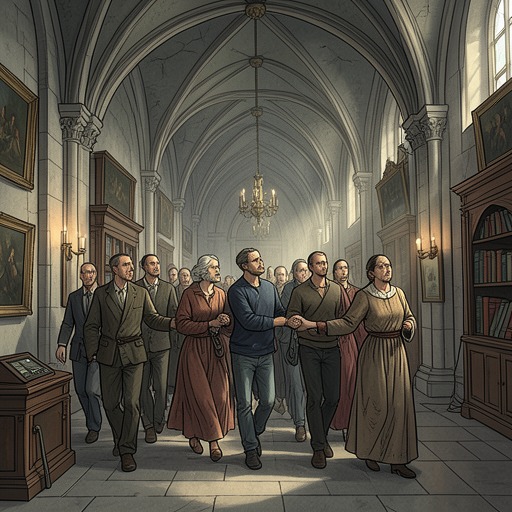
At the center of the image, a boy leads the elephant and carries a girl; one of his hands rests on the elephant. Behind the elephant are a magician and a policeman, followed by a nun, a noblewoman, a manservant, a beggar, and a dog. A small, bent man brings up the rear. The figures are identified by their roles rather than by names, but the procession recalls the company that accompanied the elephant through the snowy streets: Peter Augustus Duchene carried Adele, while Leo Matienne, Madam Bettine LaVaughn, Hans Ickman, Bartok Whynn, Tomas, Iddo, and Sister Marie went with them.
The figures are not merely arranged in a line. Each person has hold of another, connecting one figure to the next, and all look forward with their heads angled as if toward a bright light. The carving therefore gives its procession a visible structure of mutual dependence. The elephant is not isolated as a spectacle, and the people behind her are not presented as separate onlookers; together they form a linked company moving in the same direction.
From Custody to Companionship
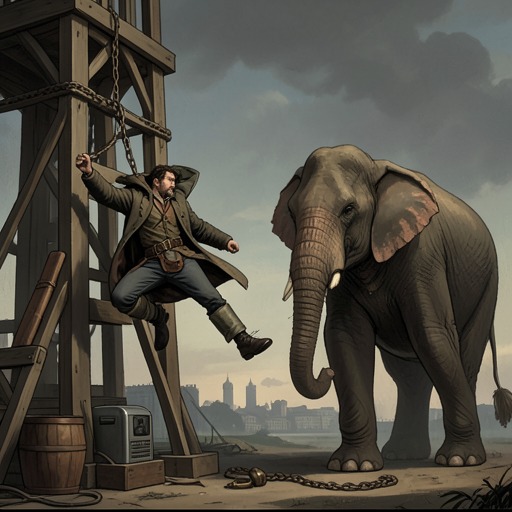
The image gains force from the story’s earlier treatment of the elephant. After she crashes through the roof of the opera house and cripples a noblewoman, the chief of police cannot find guidance in the handbook for dealing with a beast that has appeared from nowhere. One officer proposes treating the elephant as a criminal, but Leo Matienne challenges the idea that she can be guilty of an accident she did not choose. The dispute makes the carving’s inclusion of both a magician and a policeman significant: the figures associated with the extraordinary event and its policing appear within the same forward-moving group.
The elephant’s fate had also been shaped by possession and display. The Countess Quintet had a wall knocked down to install a door large enough for her, then made her property and housed her in the ballroom. On the first Saturday of each month, the people of Baltese queued to see her, bringing their private hopes and wishes to the spectacle. The carving’s procession offers a striking counter-image to that arrangement. Instead of an elephant enclosed in a grand house and viewed by a crowd, it shows her traveling with others, accompanied by people who have become part of the same journey.
Memory and Meaning
The carving preserves not only the central figures but the connections among them. Its sequence gathers people of markedly different positions—a noblewoman, a manservant, a beggar, a nun, and others—into a single chain. The image does not erase their different roles; it makes their linked passage the feature that binds them. Its composition echoes the journey’s practical acts of care, including Peter carrying Adele and Hans Ickman pushing Madam Bettine LaVaughn’s wheelchair.
As a remnant of the marvelous events, the carving gives public, durable form to a truth the city might struggle to believe. Its figures face forward together, as though toward a brightness beyond the stone. Hidden among the gargoyles yet recoverable through the help of someone who knows the way, the memorial holds together concealment and testimony: the story is not displayed plainly, but it has not disappeared. What remains is an image of a community made through successive acts of holding on to one another.